
📌 Quick Answer
Choosing a medicinal mushroom supplier comes down to ten evaluation points covering identity, testing, traceability, consistency, compliance, and formulation fit. This guide gives supplement brands a practical framework to compare organic functional mushroom powders and ingredient suppliers for immune and microbiome products.
The medicinal mushroom category is growing fast. More suppliers enter the market every year, and quality varies widely from one source to another. For brands building immune and microbiome products, the ingredient you pick shapes your finished formula's safety, label claims, and regulatory position. Strong suppliers welcome due diligence. Weak ones avoid it. The ten questions below give your procurement team a repeatable way to tell the difference.
Different Formats for Different Applications
Different mushroom formats have their valid uses, whether that is an extract, fruiting-body-only, or full-spectrum whole mushroom powder. The right choice depends on your finished product goals, dosing format, and label strategy. For a deeper look at how these formats differ, see our article on powders versus extracts for pet wellness. What matters is whether a supplier can document and defend what they produce.
The 10-Point Framework
1. Can the supplier verify species and strain identity?
Every certificate of analysis (CoA) should list the full Latin binomial, the part of the mushroom used (fruiting body, mycelium, or whole-mushroom matrix), and ideally a species authentication method such as DNA barcoding or ITS sequencing. The American Herbal Products Association recommends botanical identity testing as a baseline for herbal ingredients.
Ask for: Latin binomial on CoA, parts used, species authentication method.
2. What does a complete certificate of analysis (CoA) look like?
A complete CoA covers species identity, part used, heavy metals, microbial counts, pesticide residue, moisture, ash, and polysaccharide data. Many CoAs in the market list only a handful of these. Less thorough CoAs are a signal that testing may be thin.
Ask for: Full CoA with all parameters above and third-party lab results on request.
3. How does the supplier report its testing?
Testing only matters when a brand can see it, understand it, and trust it. The strongest suppliers treat their test results as an open conversation. They share current certificates of analysis without friction, name the labs and methods they use, and are willing to walk a buyer through how a result was produced. Weaker suppliers share a single number on a spec sheet and resist follow-up questions.
What this looks like in practice: A supplier should name the assay methods used for each tested parameter, identify whether testing was done in-house, by a third-party lab, or both, and provide access to historical CoAs on request. They should also be comfortable discussing the strengths and limits of the methods they use. Analytical science for medicinal mushrooms continues to evolve, and a supplier who acknowledges that is more trustworthy than one who claims a single number without additional context.
Ask for: Assay methods named on the CoA, lab identification, historical CoA access, and a direct conversation with the supplier's quality team.
4. Can the supplier show full traceability from spawn to finished powder?
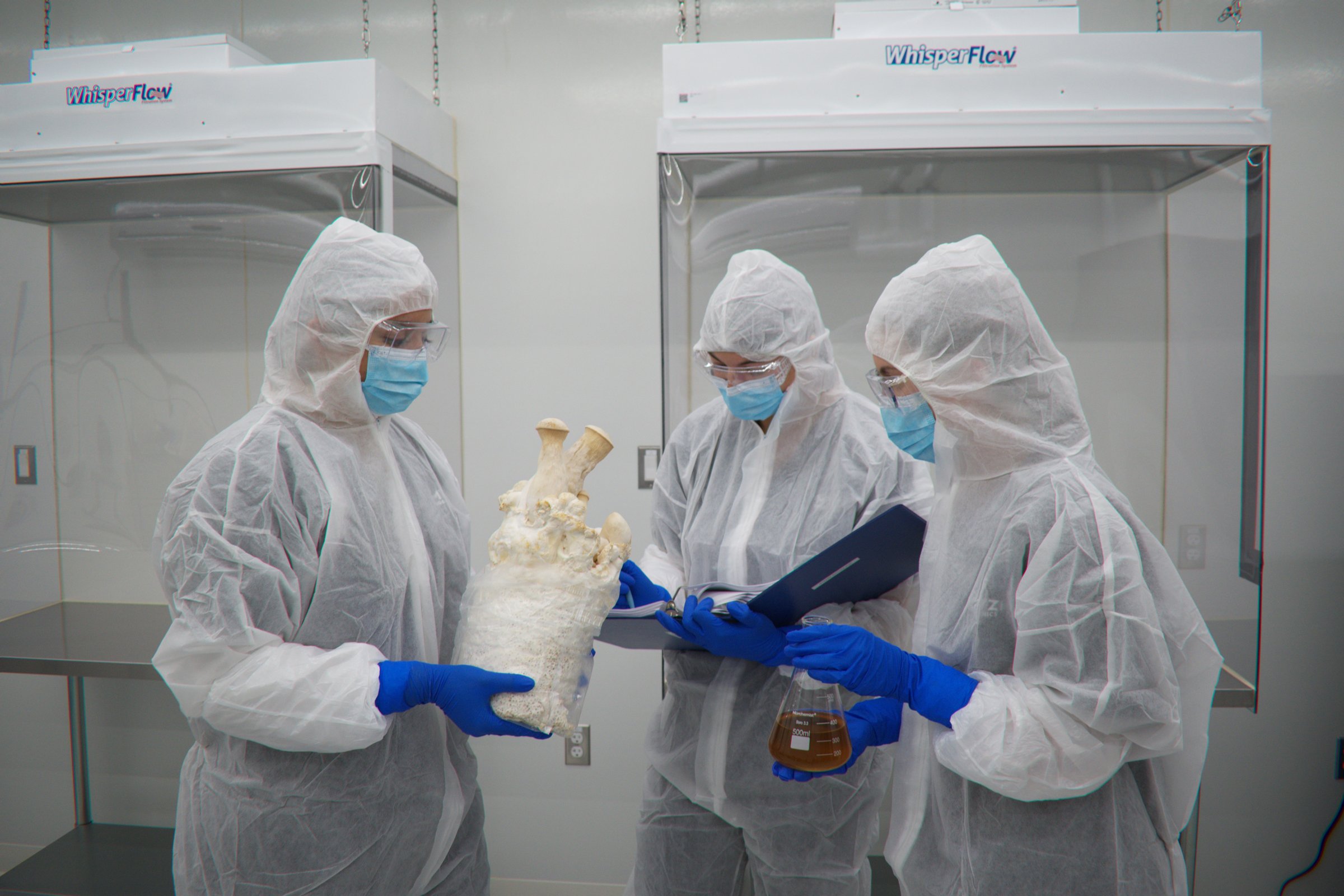
Traceability covers cultivation site, substrate, lot codes, country of origin, and chain of custody from spawn through processing and packaging. Canadian cultivation offers an additional benefit of a tightly regulated growing environment. Substrate is incredibly important as well. Different cultivation substrates produce different finished-powder profiles, and the substrate itself contributes to what shows up in testing. Strong suppliers disclose their substrate and can share testing data on the substrate alongside the finished product.
Ask for: Cultivation site, substrate disclosure, lot code system, substrate test results.
5. How does the supplier manage batch-to-batch consistency?
Consistency is what lets a brand build a reliable finished product. A strong supplier shares historical CoAs, defines tolerance ranges for key markers, and retests on a defined cadence.
Ask for: Access to historical CoA data, defined specification ranges, retesting policy.
6. Which food safety and quality certifications does the supplier hold?
Food safety certifications under the Global Food Safety Initiative (GFSI) umbrella include SQF, BRCGS, and FSSC 22000. Organic certifications include the Canadian Organic Regime through certifiers such as Ecocert, USDA NOP, and EU Organic. Each certification covers different aspects. SQF, for example, audits food safety systems from facility design through traceability.
Ask for: Current certification documents, audit scope, certifying body.
7. Is the supplier ready for the regulatory markets you sell into?
Market readiness is very important. Canada requires NNHPD licensing for natural health products, while the US operates under DSHEA with FDA labeling rules. The European Union lists certain mushroom species, including Lion's Mane, under its Novel Food framework, which affects what can be sold and how. Many brands discover these constraints late in development, and it's helpful to have a supplier who understands that landscape and can give thoughtful recommendations.
Ask for: Regulatory documentation for your target markets and evidence of prior export compliance.
8. Does the ingredient fit the formulation requirements of the product?
An ingredient that looks great on paper can still fail inside a finished product. Formulation fit is the practical question of whether the powder will behave the way your product needs it to from the moment it goes into the batch through the end of its shelf life. The answer depends on both the physical properties of the ingredient and the format you are building.
Compatibility with the other ingredients in your formula is just as important. Mushroom powders are often paired with probiotics, botanicals, vitamins, minerals, or other actives, and not every combination holds up over time. Ask your supplier whether they have stability data for their ingredient in your intended format and whether they have seen it used with the kinds of actives you plan to combine it with.
Ask for: Particle size spec, solubility data, stability data, compatibility notes.
9. How transparent is the supplier about methods and documentation?
Transparency is itself a quality signal. Strong suppliers share method sheets, origin stories, and third-party test results without requiring an NDA for standard due-diligence questions.
Ask for: Method documentation, origin story, third-party test access.
10. Is the supplier a partnership-ready manufacturer?
The best ingredient supplier for a growing brand is one that can grow with you. Look at minimum order quantities, lead times, sampling policy, R&D support, custom blend capability, and willingness to co-develop. A strong supplier will go the extra mile to support your business beyond just the ingredients.
Ask for: MOQ, lead time, sample policy, R&D and custom blend capability.
What a Strong Supplier Shows You
| Pillar | What to ask for | What a strong answer looks like |
|---|---|---|
| Identity | Latin binomial, part used | Full species name and part on every CoA, with authentication method |
| Reporting | Complete CoA | All safety and composition parameters covered |
| Testing | Methods and labs disclosed | Full method and lab transparency, historical CoAs available |
| Traceability | Lot codes and chain of custody | Spawn to powder documented, cultivation site named |
| Consistency | Historical CoAs | Defined specs, batch data available on request |
| Certifications | Current documents | GFSI-recognized food safety plus organic certification |
| Regulatory | Market documentation | NNHPD, FDA, Novel Food status addressed |
| Formulation fit | Particle size and stability | Spec sheets with full technical data |
| Transparency | Method sheets | Shared without NDA for standard questions |
| Partnership | MOQ and R&D support | Clear terms, sampling program, co-development options |
🧪 Formulator's Corner
Myzel Organics is a Canadian functional mushroom company built around the criteria above. We supply certified organic, full-spectrum whole mushroom powders to supplement, pet, and food and beverage formulators. Our facility holds SQF certification and operates under the Canadian Organic Regime through Ecocert. We cultivate on organic white sorghum, chosen for its naturally low beta-glucan baseline, and we test the substrate as part of every batch release so our data reflects the mushroom itself. Our CoAs are built for transparency, with every tested parameter clearly reported, and we are actively evaluating complementary assays as the science continues to mature.
If you are developing an immune or microbiome product and want to put this framework to work, we are happy to send a sample and a full spec sheet.
Frequently Asked Questions
What should supplement brands look for in a functional mushroom supplier?
Look for species identity on every CoA, a complete testing panel, substrate disclosure, GFSI-recognized food safety certification, organic certification, and transparency about methods. The ten-point framework above gives you a repeatable checklist.
What should a mushroom supplier's certificate of analysis include?
A complete CoA should name the species (full Latin binomial) and the part of the mushroom used, along with results for heavy metals, microbial counts, pesticide residue, moisture, and ash. It should also identify the lab that performed the testing and the methods used for each parameter. Strong suppliers share current and historical CoAs on request without friction. If a CoA lists only a single headline number or leaves out the lab and method, that is a signal to ask more questions before buying.
Why does substrate matter when sourcing medicinal mushroom powders?
Substrate is the material a mushroom is grown on, and it shapes what ends up in the finished powder. Different substrates have different nutritional and chemical profiles, and traces of that substrate can carry through to the final product and influence test results. Suppliers who disclose their substrate choice, explain why they selected it, and share testing data on the substrate itself give brands a clearer picture of what they are actually buying. If a supplier will not share this information, it is harder to interpret the numbers on their CoA.
What certifications should an organic functional mushroom powder supplier hold?
At minimum, a GFSI-recognized food safety certification (SQF, BRCGS, or FSSC 22000) and an organic certification valid for your target market (Canadian Organic Regime, USDA NOP, or EU Organic).
The Bottom Line
The strongest medicinal mushroom suppliers welcome these questions because the answers are already documented. Use this framework on your next supplier call. The suppliers who meet it are the ones worth building your immune and microbiome products on.
Disclaimer: Any statements or claims about the possible health benefits conferred by any foods, natural health products, or supplements have not been evaluated by the Canadian Food Inspection Agency (CFIA), Health Canada, or the Food & Drug Administration (FDA) and are not intended to diagnose, treat, prevent, or cure any disease.
Formulating with functional mushrooms? Source full-spectrum, organic, bulk supply from Myzel.
Our Full-Spectrum Newsletter
Stay ahead of the competition with the latest mushroom science, education, and innovation at Myzel.